
Irish Hospitality: Why You’re Never Just “Popping In”
Irish hospitality is more than tea and sandwiches. It’s warmth, care, overfeeding, and the unmistakable feeling of being looked after in every Irish family home.
IRISH HERITAGE & DIASPORAIRISH HUMOUR & SAYINGS
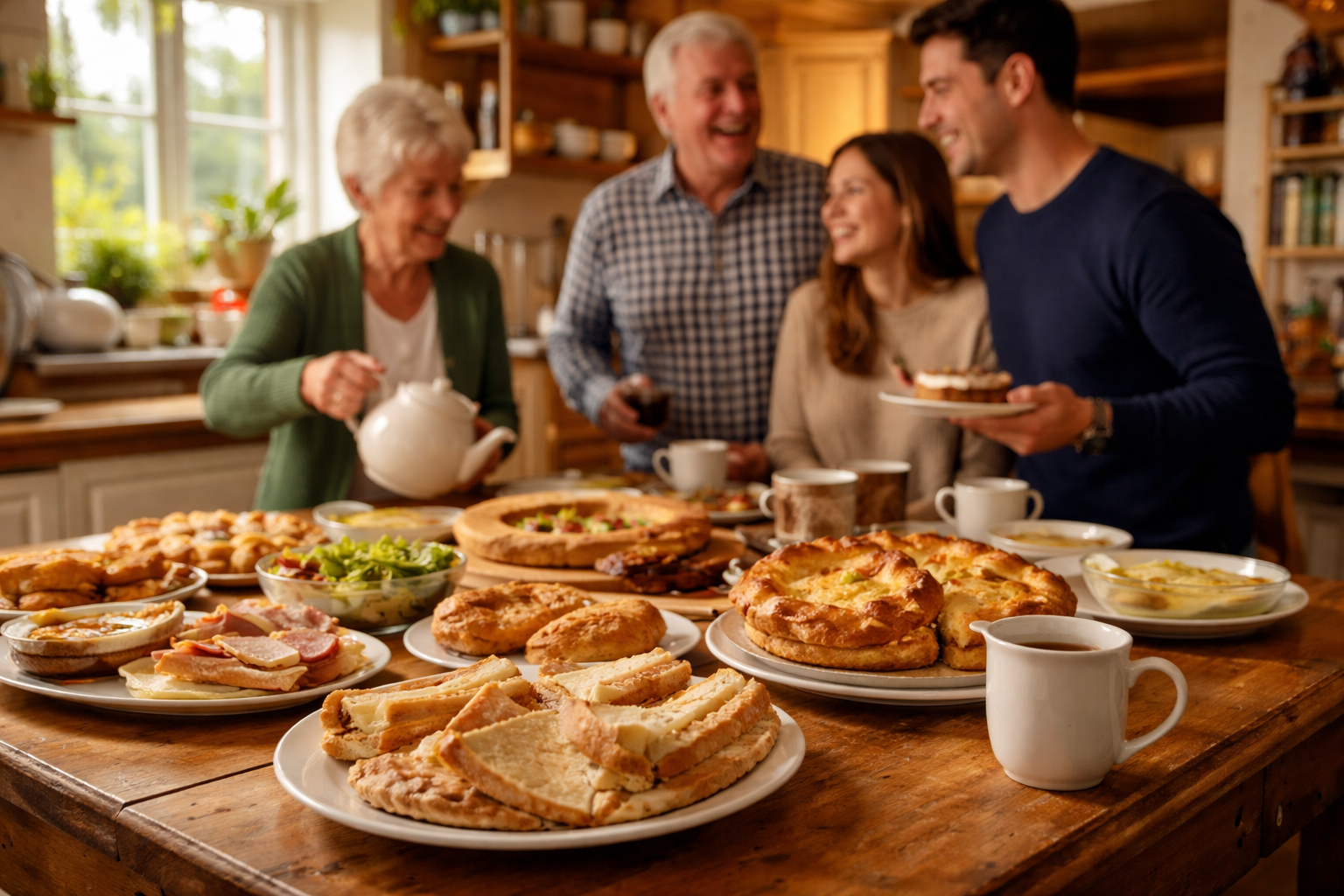
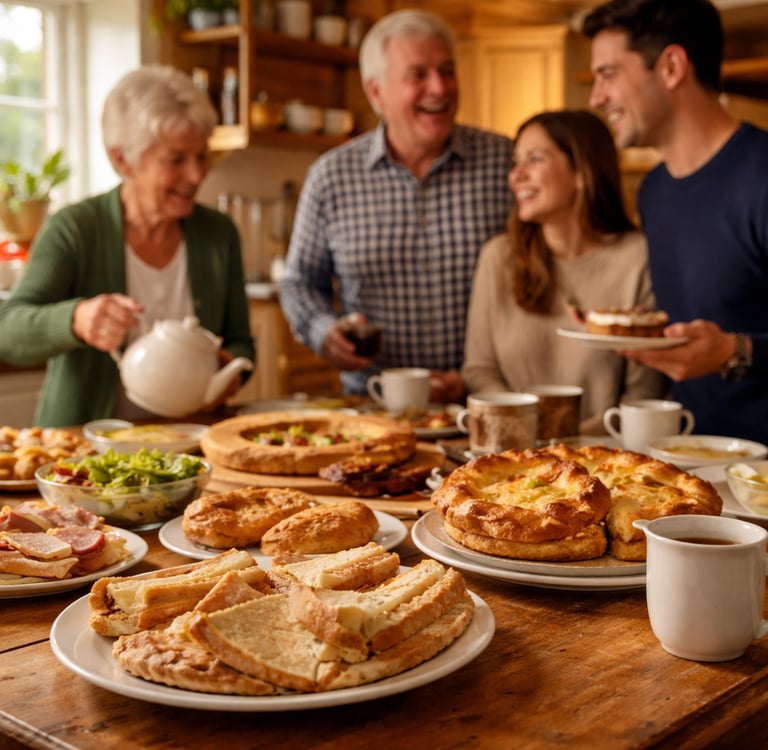
Irish Hospitality Always Starts with a Warning
If you’ve ever brought a partner, a friend, or anyone not fully initiated into Irish family life over to Ireland for the first time, you’ll know there’s always a warning conversation beforehand. I’ve had it more times than I can count. I’ll say something like, “Make sure you’re hungry before we arrive,” and, “Just so you know, we’re probably seeing three or four different relatives over the weekend.” I say it clearly. I say it seriously. I sometimes even say it twice.
And still, to this day, I’ve never seen anyone properly prepared for what follows.
Because Irish hospitality is one of those things that sounds easy enough to understand from the outside, but you don’t really get it until you’ve lived through it. It isn’t just that people are friendly. It isn’t just that homes are welcoming. It’s that in Ireland, being welcomed almost always comes with being fed, looked after, checked on, and gently ignored when you insist you’re not hungry. That idea of the welcome runs deep enough in Irish culture that even the phrase céad míle fáilte — a hundred thousand welcomes — has become one of the best-known expressions of Irish identity.
Why Tea Matters So Much in Irish Homes
What always makes me laugh is how predictable the pattern is, and yet how impossible it is to explain to someone who hasn’t seen it before. You arrive at the first house and, before you’ve even taken your coat off properly, the kettle is on. Tea comes first. Obviously. In Ireland, tea is never just tea. It’s the beginning of the visit, the sign that you’re in, settled, and about to be looked after. It’s hospitality in its opening form: familiar, immediate, and non-negotiable.
Then comes the next stage, which is where visitors start to underestimate the situation. Someone will say, as casually as if they’re offering you a mint, “Sure, have a sandwich, won’t you?” At this point, most newcomers still think they’re in control of events. They imagine they can politely decline, or accept something small, or pace themselves because there are other visits ahead. That confidence doesn’t last long.
Because if you accept the sandwich, it will immediately be interpreted as proof that you were hungrier than you let on. If you refuse it, that will be treated as temporary confusion on your part, rather than a final answer. Either way, food is arriving. You finish what’s in front of you, and before you’ve had time to gather yourself, someone notices the empty plate and says something along the lines of, “Ah look, you ate those fierce quick, you must be starving.” Then out comes something else. A second round. A plate that “was only there anyway.” And then, because apparently we are not yet done, cake appears. There is always something sweet to “finish off.”
Then You Realise It Was All Prepared Anyway
And the best part is this: when you finally bring your plate into the kitchen, partly to be helpful and partly to see whether this has all been improvised in real time, you realise none of it was spontaneous. It was all prepared in advance. The sandwiches were ready. The cake was waiting. The whole thing was always happening. You were never being casually offered a bite of something. You were being quietly pulled into a fully operational family feeding schedule.
Then you get back into the car, mildly stunned, and head to the next house, where the entire process begins again.
That is the part nobody believes when you try to explain it in advance. People hear, “We’re calling in to see a few relatives,” and think this means a quick hello, a bit of chat, and maybe one substantial meal somewhere along the line. What it actually means is four separate houses, four separate kettles, four separate rounds of “Will you have something?” and four sets of family members all working on the assumption that you have not been fed properly by whoever had you last.
Why Irish Hospitality Is About More Than Food
By the end of the weekend, visitors are usually somewhere between amused, overwhelmed, and physically incapable of another sandwich. But what they always remember is not just the volume of food. It’s the determination behind it. There is something almost ceremonial about the insistence. You are not being offered food because somebody has misread the situation. You are being offered food because that is how care is shown.
That, for me, is the real heart of Irish hospitality. It isn’t performance. It isn’t polish. It isn’t the kind of hospitality you find in a brochure, all styled tables and carefully planned gestures. In Irish homes, hospitality is lived. It is practical. It is slightly relentless at times. It has a rhythm to it that says, “You’re here now, so you’ll be looked after properly.” Official tourism and hospitality guidance in Ireland still centres that idea of warmth, courtesy, food, and making visitors feel genuinely cared for during their stay, which says a lot about how deeply this instinct is woven into the wider culture.
Where That Instinct Comes From
A lot of that, I think, comes from history as much as habit. Ireland has long carried a cultural memory shaped by hardship, scarcity, and emigration. In societies that have known those things, food becomes more than food. It becomes reassurance. It becomes proof that there is enough to share. It becomes a way of refusing coldness, distance, or indifference. Even as Ireland’s food culture has evolved and gained international attention for its quality and regional experiences, that older instinct still survives inside the family home in a very recognisable way.
You can also see that hospitality is not limited to private family life. It runs through the way Ireland presents itself more broadly. The language of welcome, the emphasis on friendliness, and the expectation that a guest should be made comfortable are all part of how Irishness is still understood, both at home and abroad. That doesn’t mean every interaction is magically perfect, and it certainly doesn’t mean Ireland has a monopoly on kindness, but the idea of the warm Irish welcome has remained remarkably durable. Even older Bord Fáilte material and contemporary tourism messaging still lean on that same image of Ireland as a place where welcome matters.
Irish Hospitality Is About More Than Feeding People
What makes family hospitality in particular so memorable, though, is that it has very little to do with appearances and everything to do with belonging. If you’re brought into an Irish home, especially through family, you are not really treated like a formal guest for very long. You are folded in. Fed. Watched. Asked questions. Given tea. Given more tea. Sent away with leftovers if the timing is right. It doesn’t matter whether you arrived as someone’s partner, someone’s friend, or someone who’s only vaguely connected through three different branches of the family. Once you’re there, you’re in the system.
That is why it always makes me laugh when I try to prepare people beforehand. I can tell them to arrive hungry. I can tell them there’ll be several houses. I can tell them lunch won’t just be lunch. But nothing really prepares someone for the moment they realise that what looked like a casual family weekend is actually a rolling festival of tea, sandwiches, hot meals, cake, and repeated emotional blackmail disguised as politeness.
And yet, nearly everyone who experiences it comes away saying the same thing. They’re amazed by how welcomed they felt.
In Ireland, You’re Never Just Visiting
That’s the part worth holding onto. Because under all the joking, all the overfeeding, and all the impossible efforts to leave a house without being offered one last thing, Irish hospitality is really about making sure nobody feels like an outsider once they’ve crossed the door. It’s about turning a visit into something warmer than a visit. It’s about making people feel that they’re not just expected, but genuinely wanted there.
So yes, I still warn people before we go. I still tell them to come hungry. I still mention, very casually, that we’ll be seeing a few different relatives over the weekend. And I still know, as I’m saying it, that none of it will truly prepare them.
Because Irish hospitality is one of those things you don’t understand from explanation. You understand it when you’re halfway through your second round of sandwiches in the first house, staring at a plate of cake you definitely don’t have room for, while someone in the kitchen is already asking whether you’d take another cup of tea.
That’s when it clicks.
In Ireland, you’re never just popping in.
You’re being looked after.
As always, slán go fóill,
Conor Dwyer
Founder, Gaelic Generations


Gaelic Generations
Wear Your Heritage. Carry Your Story ☘️
Contact
Newsletter
support@gaelicgenerations.com
Gaelic Generations ©2026. All rights reserved
Business Location: 43 The Green, Rugby. CV22 7LZ
Independent Irish brand • Made-to-order products • Free tracked shipping • Customer support available.

