free WORLDWIDE shipping
The Irish Goodbye Explained
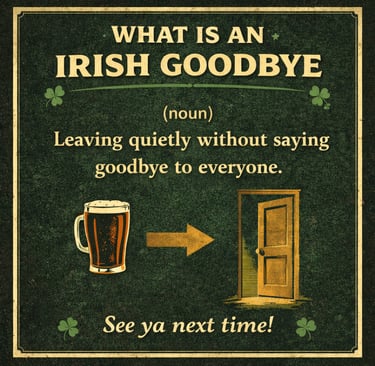
What is an Irish goodbye, you ask? In this blog, you'll discover the meaning, likely origins, and why this famous party exit says more about Irish humour than bad manners.
Conor Dwyer
3/15/20265 min read


Introduction
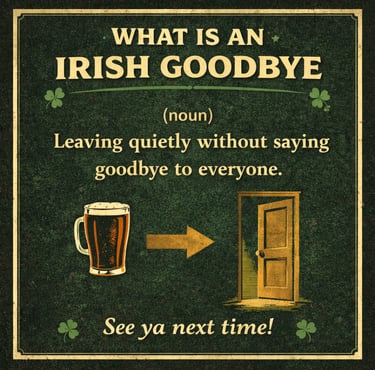
If you’ve ever slipped out of a pub, wedding, family party or night out without announcing your departure to half the room, then you already understand the basic idea behind the Irish goodbye. You don’t gather everyone for a speech. You don’t make a dramatic scene at the door. You don’t spend 25 minutes doing the rounds, hugging people you only met two hours ago and promising to meet again soon. You simply spot your moment, finish your drink, throw on your jacket, and vanish. Quietly. Efficiently. Ideally before anyone notices.
The phrase itself is widely used to describe leaving a social gathering without saying goodbye, and it’s often used interchangeably with Irish exit. Dictionary.com defines it as abruptly leaving a party without telling anyone, and it notes that the exact origin of the phrase is unclear. It also points out that similar expressions exist in other cultures, including French leave, which goes back much further.
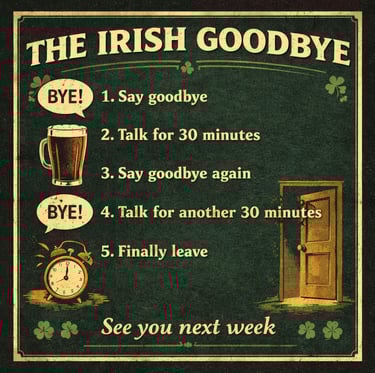
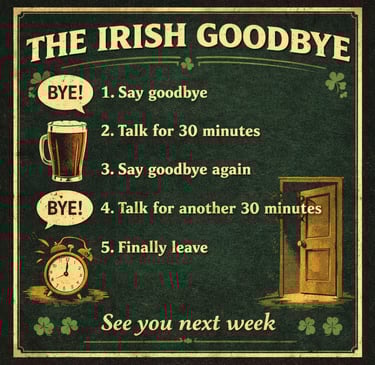
Now, whether it’s actually an Irish thing is a different question entirely. That’s where things get interesting. Because in my experience, the phrase “Irish goodbye” says less about Irish people literally disappearing from rooms and more about the social reality of trying to leave an Irish gathering in the first place. Anyone who grew up around Irish family events, crowded pubs or weddings knows that once you attempt to leave, you’ve basically started a second event. You say goodbye to one person and suddenly you’re pulled into another conversation. Someone asks where you’re off to. Someone else insists you stay for one more. A third person reminds you that you haven’t heard the story about someone’s cousin in Clare yet. What should have been a thirty-second exit turns into another forty minutes.
That, to me, is the real reason the Irish goodbye makes perfect sense. It isn’t about being rude. It’s about self-preservation.
Beyond Home
One of the funniest things about the phrase is that it isn’t even especially common in Ireland itself. Ireland Calling notes that it’s used far more in the United States than in Ireland, and that many Irish people encounter it abroad more than at home. That rings true. I’d say plenty of Irish people recognise the behaviour instantly, but the label often feels imported.
Still, the idea behind it is completely relatable. We’ve all had that moment where we know that if we stop to say goodbye properly, we’re finished. We’ll never get out. There’s almost a tactical element to it. You wait for the perfect window. Someone turns away. A song starts. The group gets distracted. You make your move. It’s less an exit and more a coordinated escape.
And to be fair, there’s a logic to it.
A full goodbye at an Irish event can be exhausting. You don’t just say goodbye once. You say it in stages. First you announce your intention to leave. Then you explain why you’re leaving. Then someone objects. Then you say you really have to go. Then you get pulled into one final story. Then someone says, “Ah go on, one more for the road.” By the time you actually make it outside, you could have stayed for another two rounds and a bag of chips.
That’s why I’ve never really seen the Irish goodbye as bad manners. If anything, it’s often the only practical solution.
There’s also something quite Irish about the contradiction of it all. We’re supposed to be famous for conversation, hospitality, and long goodbyes, and that’s exactly why leaving quietly becomes so tempting. It’s the same social energy that makes Irish pubs feel warm and welcoming. You can walk into a pub in Ireland and end up talking to people you’ve never met before, laughing over nothing in particular, and hearing stories that start in 1987 and only end when the bar staff begin stacking stools. That kind of atmosphere is brilliant when you’re settling in, but absolute chaos when you’re trying to get home.
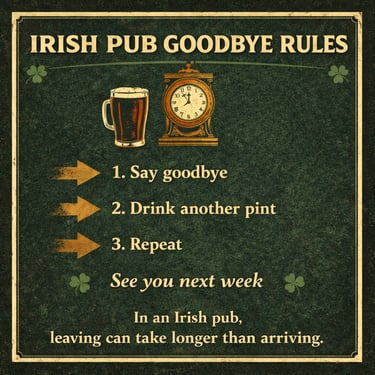
And pubs are where the Irish goodbye really comes into its own. In my experience, a proper Irish pub has its own exit rules. Rule one: never announce your departure too early. Rule two: if you get caught near the door, you’re in trouble. Rule three: if someone says, “Before you go…”, accept that you may still be there in half an hour. This is why slipping away between conversations can feel less like bad form and more like a learned skill.
Origins
It’s also why the phrase has stuck. It’s memorable, a bit cheeky, and close enough to reality to make people laugh. Dictionary.com notes that the origins are fuzzy, with some people linking it to Irish-American use in Boston and others offering different theories, but none of the explanations are especially definitive. What does seem clear is that the phrase caught on because people recognised the behaviour immediately.
Interestingly, etiquette advice today is a bit more forgiving than people might expect. Better Homes & Gardens recently noted that at larger gatherings, an Irish goodbye can be acceptable, especially if you follow up with thanks later or if making the rounds would be exhausting. That feels about right to me. There’s a big difference between disappearing from a massive party and sneaking out of a tiny dinner where the host is still serving dessert. Context matters.
That’s probably the best way to think about it. The Irish goodbye isn’t really about disrespect. It’s about reading the room. Sometimes it’s practical. Sometimes it’s funny. Sometimes it’s the only way you’re getting home before midnight. In big social settings, it can even be the kinder option. No disruption. No fuss. No dragging a goodbye into a public performance.
And maybe that’s why people love the phrase so much. Because it describes something most of us have either done or desperately wanted to do. It captures that universal moment when your social battery is gone, your coat is on, and you know that if anyone catches your eye, you’ll be trapped for another twenty minutes.
Slán
The funny thing is, even when you manage a perfect Irish goodbye, someone always notices eventually. The next day you’ll get the message: “You disappeared.” As if you were part of a magic act. As if leaving quietly wasn’t the plan all along.
For me, that’s what makes it such a great bit of Irish humour. It isn’t really about the mechanics of leaving. It’s about the social dance around leaving. The delaying, the storytelling, the one-more-minute culture of Irish gatherings. The Irish goodbye only makes sense because the ordinary Irish goodbye is so long-winded in the first place.
So yes, the phrase may not have originated neatly in Ireland, and it may be more widely used abroad than at home. But the spirit of it? That’s instantly recognisable. Anyone who has ever tried to leave an Irish pub, family party or wedding without becoming part of another conversation will understand exactly why it exists.
And if all of this sounds painfully familiar, then you already know the truth: sometimes the only way to leave properly is not to leave properly at all.
Slán go fóill,
Conor Dwyer
Founder, Gaelic Generations
Go raibh maith agat for reading, and wherever you are in the world — never forget where home is.
If you enjoy the kind of everyday Irish humour that comes from real life, pub nights and painfully familiar social habits, have a look at our Irish Exit Strategy T-Shirt. It was made for exactly this sort of moment.
Gaelic Generations
Wear Your Heritage. Carry Your Story.
Celebrating Irish identity across generations worldwide ☘️
Contact
Newsletter
support@gaelicgenerations.com
© 2026. All rights reserved
Privacy Policy
Return & Refund Policy
Contact Us
About Us
Business Location: 43 The Green, Rugby. CV22 7LZ